

New Issue of the MThA Journal "Bogoslovskiy Vestnik" Published
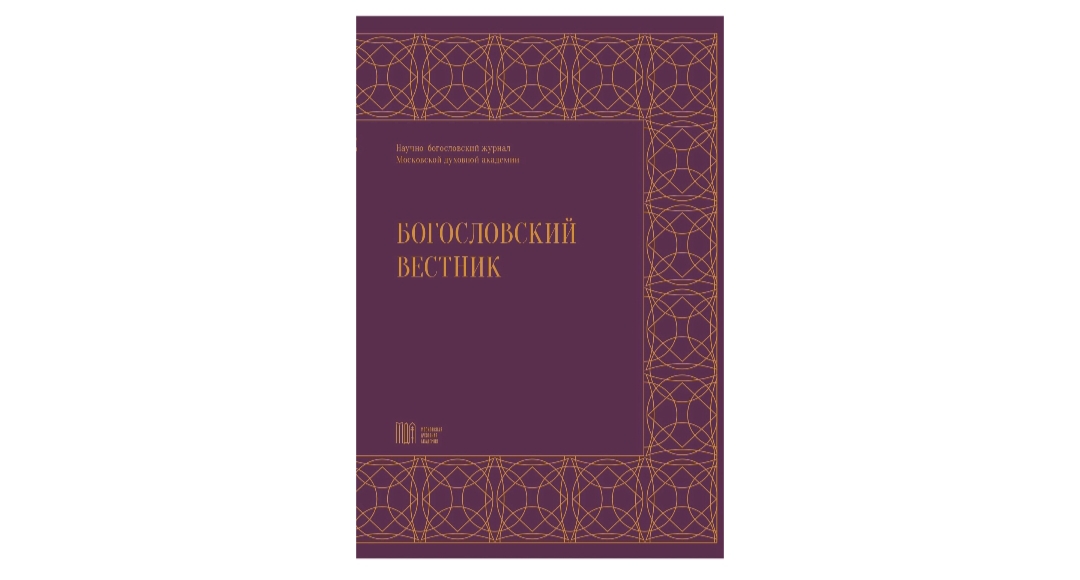
The third issue (No. 3/58) of the Moscow Theological Academy's "Bogoslovskiy Vestnik" has become a significant event for the scholarly community interested in Orthodox theology. This publication, continuing the journal's traditions since 1892, spans 384 pages and focuses on key aspects of biblical studies, theology, patristics, church history, and practical theology. The issue emphasizes the continuity of patristic traditions with contemporary interpretations, making it valuable for students, researchers, and clergy.
The new issue unites research in which classical theological subjects, biblical exegesis, eschatology, anthropology, patristics, and canon law are reinterpreted considering modern methodological approaches and current intellectual debates.
The second part of the article by Protopriest Boris Timofeev and M.A. Skobelev, "The Motif of Renewal in the Book of the Prophet Isaiah…" (pp. 18–34), offers a deep analysis of how key prophecies of Isaiah are read in Brevard Childs's canonical approach and in the tradition of the Church Fathers. The authors show that beneath the external similarity of biblical formulas lie fundamentally different theological horizons: for modern biblical studies, renewal is rooted in Israel's history, whereas patristic exegesis sees in these texts a prototype of the eschatological transfiguration of the world in Christ.
The article by Priest Dmitry Baritsky, "Narrative Hermeneutics and Its Significance for Orthodox Biblical Scholarship" (Part 2) (pp. 35–57), introduces the reader to the intellectual history of the "narrative turn" of the 20th century. The author not only describes the main tenets of narrative hermeneutics but also raises the question of the limits of its applicability in the Orthodox tradition, showing how narrative can be not merely a literary form but a mode of theological thinking.
In the article by A.V. Lozhkin, "Sacred History as a Model for Generalizing Biblical Knowledge" (pp. 58–75), a little-studied epistemological theme is revealed: how a coherent picture of biblical knowledge was constructed in Russian biblical studies of the 19th – early 20th centuries. The author shows that "sacred history" was not a naive retelling of biblical events but a considered scholarly-educational model combining exegesis, dogmatics, and pedagogical tasks.
The article by Antal Nebolsin, "Two Eschatological Battles and Two Faces of World Evil…" (Part 1) (pp. 76–90), offers an original reading of the Apocalypse, in which the two descriptions of the final battle are understood as theologically distinct responses to different forms of evil—inert idolatry and the organized anti-Christian system of the "beast". This approach allows one to avoid both literal millenarianism and the reduction of eschatology to symbolism.
In the work by G.K. Kutasevich, "The Method of 'Reverse Perspective' in the Eschatological Views of Metropolitan John Zizioulas" (pp. 91–108), eschatology appears not as a section of dogmatics but as a principle for constructing the entire theological system. The author shows how the future Kingdom of God in Zizioulas's thought determines ecclesiology, the eucharistic understanding of the Church, and personalist ontology, and also analyzes the strengths and vulnerabilities of this approach.
The article by S.A. Kolesnikov, "The Wrath of God and Sociality" (pp. 109–130), boldly brings theology into the space of public debates. The author views the demographic crisis not only as a socio-economic problem but also as a symptom of spiritual malaise, showing that the theology of God's wrath can offer a different, deeper language for analyzing social catastrophes.
In the research by S.V. Kravchuk, "Palamite Theology in the Sophiological System of Protopriest Sergei Bulgakov" (pp. 131–147), the reader is introduced to a subtle reconstruction of how the Byzantine doctrine of essence and energies was received and reinterpreted in Russian religious philosophy. The author argues persuasively why the attempt to synthesize Palamism and Sophiology proved to be internally contradictory.
The article by A.Yu. Buyanov and A.D. Ponomarev, "Individual vs Person…" (pp. 148–168), addresses one of the key themes of 20th-century theological personalism. Comparing the legacy of Metropolitan Anthony of Sourozh and Archimandrite Sophrony (Sakharov), the authors show that overcoming individualism is conceived by them primarily as a spiritual-practical path, not as an abstract theory.In the article by Hegumen Adrian (Pashin) and V.E. Elimanov, "The Teaching of St. Anastasius of Sinai on the Image and Likeness of God" (pp. 169–198), theological anthropology is revealed as the point of intersection of Trinitarian theology, Christology, and soteriology. The authors show that the distinction between image and likeness is not formal but is connected with the dynamics of deification (theosis) and the life of the Church.
In the article by Hegumen Adrian (Pashin) and V.E. Elimanov, "The Teaching of St. Anastasius of Sinai on the Image and Likeness of God" (pp. 169–198), theological anthropology is revealed as the point of intersection of Trinitarian theology, Christology, and soteriology. The authors show that the distinction between image and likeness is not formal but is connected with the dynamics of deification (theosis) and the life of the Church.
The research by A. Nakaidze, "The Influence of Blessed Theodoret of Cyrus on the 'Amphilochia' of St. Photius" (Part 1) (pp. 199–217), demonstrates how Byzantine exegesis combined respect for the authority of predecessors with creative freedom. The author traces where St. Photius follows the Antiochene tradition and where he fundamentally reworks it.
In the third part of the cycle by M.A. Gorshenin, "Reconstruction of the Theological Epistemology of St. Peter of Damascus" (pp. 218–236), the phenomenon of spiritual contemplation as the highest type of knowledge of God is considered, surpassing rational forms of knowledge and rooted in revelation.
The article by L.A. Karelina, "Protopriest Alexander Gorsky: Founder of the MThA Scientific School" (pp. 237–265), shows how in the mid-19th century a full-fledged scholarly environment was formed at the Moscow Theological Academy, where exegesis, church history, and theology developed as interconnected disciplines.
The work by Protopriest Sergei Zvonarev, "Contacts of the Moscow Patriarchate with the Albanian and Chinese Churches" (pp. 266–277), is based on archival materials and reveals the dramatic history of church diplomacy under conditions of severe state pressure and ideological control.
The article by Deacon Evgeny Anisimov, "Textual Features of Additional Articles in Manuscripts of the Gospel of St. Nikon of Radonezh" (pp. 278–292), introduces the reader to the world of manuscript culture, showing how the "literary escort" shaped the theological context for reading the Gospel.
The research by Hieromonk Dalmat (Yudin) and Priest Ioann Perminov, "Byzantine and Slavonic-Russian Akathists…" (pp. 293–316), significantly expands the source base for studying the akathist tradition and reconstructs the process of its establishment in Rus' as complex and multi-stage.
In the article by A.R. Airapetov and O.L. Vasilyev, "Analysis of the Interaction of Orthodox Practical Theology and Juridical Science" (pp. 317–335), the category of justice is considered as a point of intersection between theological and legal thinking, allowing for a new perspective on the foundations of modern Russian legal culture.
The article by N.S. Semenova, "'Church Law' v. 'Canonical Law'…" (pp. 336–353), sums up the long-standing debate in church-legal science and offers a conceptually refined distinction of terms, relevant to contemporary legal realities.
The issue concludes with reviews by O.V. Sharshukova, R.S. Solovyov, and A.S. Kuprin on A.G. Slednikov's "Textbook of Christian Latin" (pp. 354–371) and by V.A. Tulyanov on the textbook by A.Yu. Polunov on the history of state-confessional relations in Russia (pp. 372–381).
The new issue can be viewed on the website of the journal "Bogoslovskiy Vestnik".
MThA Press Office