

VI All-Russian Scientific-Practical Conference "Justinian Readings"
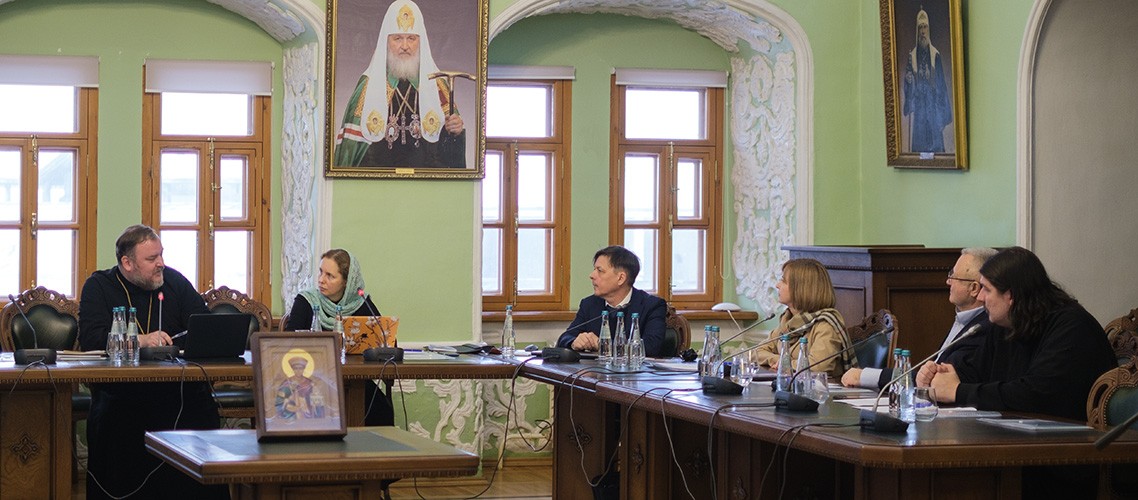
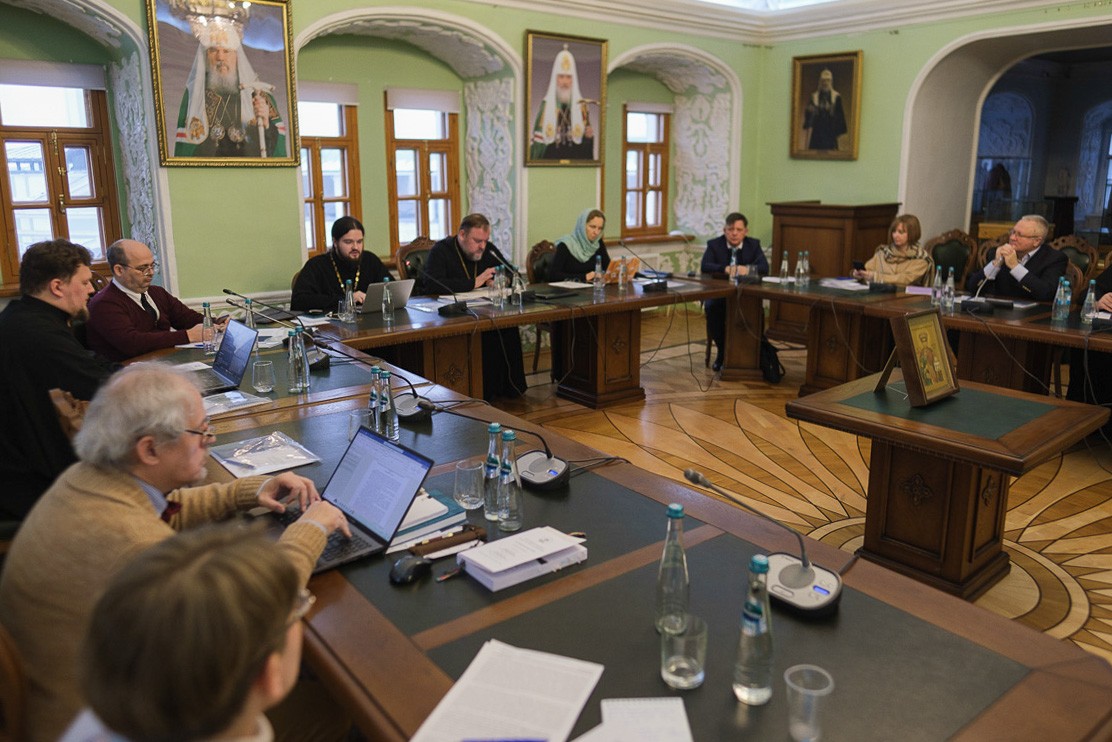
On November 27, 2025, the feast day of the Holy Emperor Justinian the Great, the Department of Church-Practical Disciplines of the Moscow Theological Academy held its now-traditional VI annual All-Russian Scientific-Practical Conference "Justinian Readings".
The conference opened with a report by the Head of the Department of Church-Practical Disciplines of the Moscow Theological Academy, Protopriest Alexander Zadorzhny, titled "The Theological Method in Canonical Studies". The report attempted to examine the epistemological and methodological foundations of canon law as a scientific and theological discipline. Such research is necessary to overcome the identity crisis of modern canonistics, which finds itself between legal positivism and ecclesiological nihilism. Particular attention was paid to the phenomenology of the theological method in light of the transcendental Thomism of Bernard Lonergan and contemporary philosophy of science (lecturers from PSTGU, Prot. K. Polskov, K.M. Antonov). The report noted the strengths and weaknesses of the reception of Western discussions on the nature of canonistics (the Munich school of K. Mörsdorf, the Navarra school of E. Corecco) and the concept of canonical law as ordinatio fidei ("prescription of faith"). Based on materials from the judicial practice of the Supreme Church Court of the Russian Orthodox Church and codification projects from the mid-20th century (the commission of Metropolitan Nikodim (Rotov)), the manifestation of the theological method in action was demonstrated.

In the report by the Head of the Center for Law and Culture Studies, Head of the Department of Theory and History of State and Law at the Law Faculty of the State Academic University for the Humanities, Yu.V. Erokhina, titled "Modern Aspects of the Legal Acculturation of the Church Law of the Russian Orthodox Church in the Russian Federation", an attempt was made to identify the specifics and mechanisms of integrating the church law of the Russian Orthodox Church with the Russian legal system at the present stage. The influence of church law on secular legislation and law enforcement practice was outlined. The speaker concluded that the legal acculturation of the church law of the Russian Orthodox Church is a dynamic process of mutual assimilation of church-legal norms and secular law norms, forming unique hybrid legal mechanisms in contemporary Russia.
Associate Professor of the Department of Church-Practical Disciplines of the Moscow Theological Academy, Head of the Department of Church History and Church Law of the All-Church Postgraduate and Doctoral Studies named after Saints Cyril and Methodius, Associate Professor of the Department of Biblical-Theological Disciplines of the Tula Theological Seminary, Candidate of Juridical Sciences N.S. Semenova presented a report on the topic "On the Role of International Law in the Implementation of Church Law". The report emphasized the difference in approaches to implementing the right to freedom of conscience and religion in the pre-revolutionary era and the modern period. From 1945 to 2025, an independent branch was formed within international law — international human rights law — which is based on one of the fundamental principles of international law: the principle of respect for human rights and fundamental freedoms, including freedom of thought, conscience, and religion. At the international level, states have undertaken obligations to guarantee every person the right to freedom of thought, conscience, and religion. Discrimination based on religious affiliation is prohibited. States are obligated to ensure the ability of believers to fully follow their rules of life according to their faith, provided these rules do not violate current state legislation. Moreover, state legislation cannot contain restrictions on the right to freedom of conscience that violate international obligations. Unlike the pre-revolutionary period, the state does not have the right to create norms of church law, as this is the exclusive competence of the Church, which places the internal law of the Church as an independent legal system. This approach is guaranteed not only at the national level but also internationally within established international legal mechanisms for protecting religious freedoms (treaty-based and charter-based). The existence of these mechanisms contributes to the formation of a uniform approach by all states to ensuring the right to freedom of conscience and religion and, consequently, the ability of Church members to live in accordance with the rules of church law within the territories of various states.
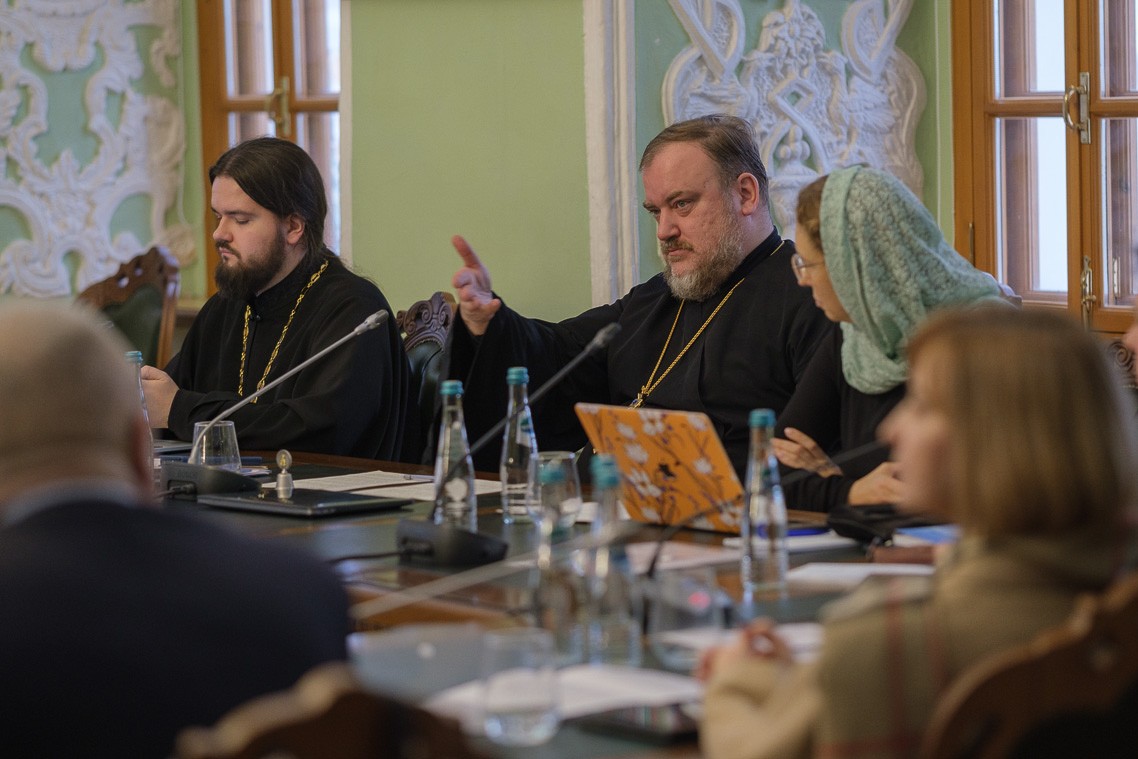
The Secretary of the T.V. Barsov Society for the Study of Church Law (Barsov Society) of the St. Petersburg Theological Academy of the Russian Orthodox Church, Director of the SPbDA Publishing House, D.V. Voluzhkov, in his report "On the Question of Presumptions of Guilt and/or Innocence in the Church Court", examined the question of the presence or absence in the legal proceedings of the Russian Orthodox Church of such well-studied tools of legal technique in secular law as presumptions of guilt/innocence, as well as the reasons for their presence/absence. Methodologically, the author's reasoning is built around the key feature of legal presumptions—the distribution of the burden of proof. The author also uses two approaches: theoretical (where his judgments are based on the "Regulation on the Church Court" from 2008) and practical (using materials from a master's thesis defended at SPbDA in 2022 on the contemporary diocesan court). The following conclusions are made: the regulation (Article 6) does not contain a presumption of innocence; the text of the article, which resembles it, is not a presumption at all; and the 28th rule of the Local Council of Carthage, to which this text refers, contains a presumption of guilt. The practical approach also confirms: the church court, in fact, uses precisely a presumption of guilt. Answering the question of whether there should be a presumption of innocence in the church court, the author reminds us of the discussion at the Barsov Society round table on June 23, 2023, on the problem of "adversarial nature" in the church court, and of pre-revolutionary proposals ("Draft of Basic Provisions for Reforming the Spiritual-Judicial Part", 1873) to introduce the position of "spiritual prosecutor" and, consequently, a "spiritual defender". The possible problem of training and educating "spiritual prosecutors" and "spiritual defenders" is immediately noted. In conclusion, the question of theological analysis is raised, i.e., the correspondence of legal presumptions to Divine law and Sacred Scripture, which should be decisive for their place in church law.

V.V. Lavrov, Head of the Department of State-Legal Disciplines of the St. Petersburg Law Institute (branch) of the University of the Prosecutor's Office of the Russian Federation, presented a communication titled "The Legislation of the Russian Federation on the Transfer of Property of Religious Significance to Religious Organizations in the Context of Preserving and Strengthening Russian Traditional Spiritual-Moral Values". As the speaker noted, legal regulation in the sphere of culture has recently become the subject of close attention by Russian society. This direction received a powerful impetus after amendments were made to the Constitution of the Russian Federation in 2020. In connection with the new amendments introduced into the fundamental law, culture is elevated to the rank of constitutional values. The new edition of Article 68 of the Constitution of the Russian Federation enshrines the state's attitude towards culture as the unique heritage of the multinational people of the Russian Federation. Religion is the core of cultural tradition, a consequence of which is the circumstance that a significant part of the cultural heritage of the Russian Federation is of religious origin. The preservation of the historical and cultural heritage of the peoples of Russia is one of the directions of the state policy of the Russian Federation for the preservation and strengthening of traditional values. In the sphere of preserving cultural heritage, religious organizations of the Russian Orthodox Church can act as rightsholders of cultural values and bear the duties imposed on them by law, resorting in some cases to financial support from state authorities and local self-government bodies. Despite changes in current legislation, the process of transferring property of religious significance to the Russian Orthodox Church from state and municipal ownership proceeds with significant difficulties, due to a lack of necessary budget funding. Furthermore, there are instances indicating, in many cases, a lack of desire on the part of state authorities and local self-government bodies to take the necessary measures for the restitution of church property. A change in the vector of state policy for the preservation and strengthening of Russian traditional spiritual-moral values could contribute to optimizing the processes of transferring state property of religious significance to religious organizations of the Russian Orthodox Church.
The Rector of the Kazan Theological Seminary, Priest Nikita Kuznetsov, in his report dedicated to the legal regulation of missionary activity in Russia during the Soviet period, traced the development of the Soviet state's attitude towards the Russian Orthodox Church based on the texts of the 1977 Constitution of the USSR, the 1978 Constitution of the RSFSR, and other regulatory legal acts of the 1960s–1990s. Largely despite the fact that this period declared broad freedoms of religion and a prohibition on any forms of discrimination based on religious affiliation, missionary activity was virtually impossible. However, legislation in this sphere progressively softened, gradually leading to a fundamentally new form of church-state relations.
The afternoon session opened with a presentation by an employee of the Administration of the Moscow Patriarchate, Master of Theology Deacon Ioann Kizyun, titled "Oikonomia in Church Law. Development of the Concept's Content and Problematics of Defining its Boundaries". The report was dedicated to the use of the term "oikonomia" in church law. The main focus was on the history of the term's development and its different meanings. The first part of the report showed how the understanding of the term "oikonomia" changed over time. Its meanings were considered, starting from profane ones and ending with its use in the New Testament and canonical decrees. Particular attention was paid to the emergence of new meanings of the term "oikonomia", especially among the Holy Fathers, classical interpreters of the canons, and in the Pedalion of St. Nicodemus of the Holy Mountain. Differences in the practice of applying oikonomia in various Local Churches concerning the reception of non-Orthodox were described. At the end of the report, a methodology for studying the contradictions associated with this term is proposed.
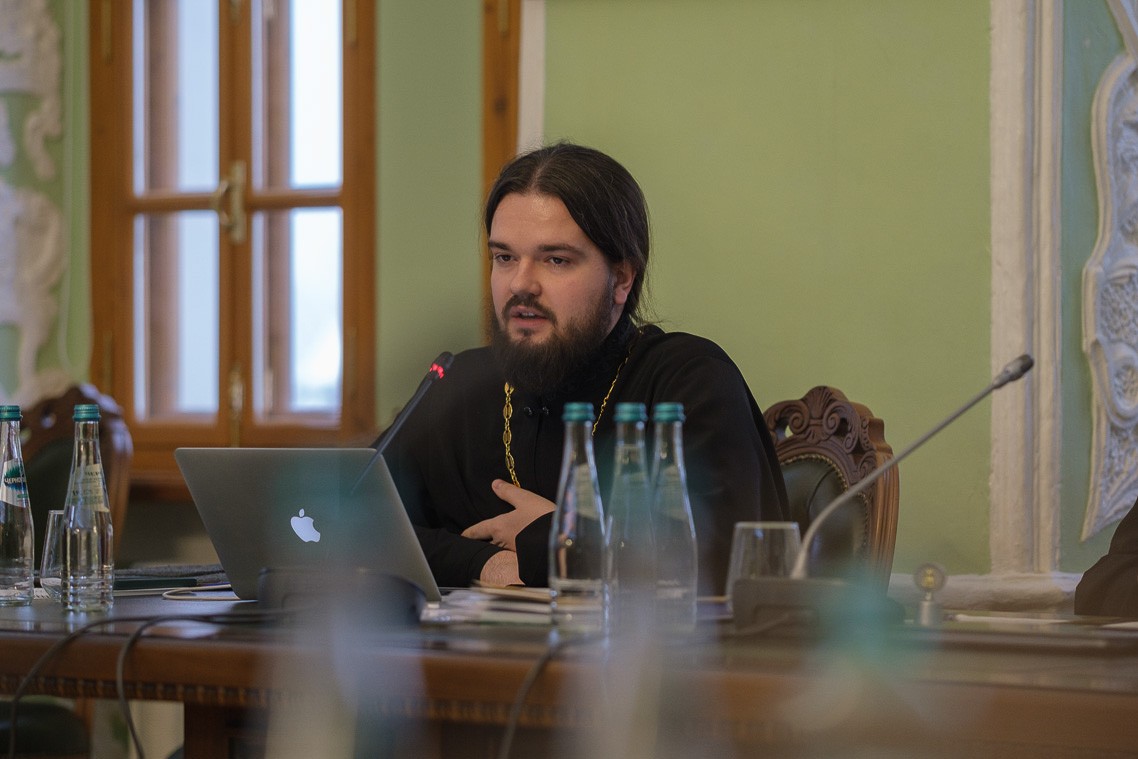
Associate Professor of the Department of General and Church History of the Kazan Orthodox Theological Seminary, Associate Professor of the Department of National History and Archival Studies of IMOIV KFU, Candidate of Historical Sciences A.Yu. Mikhailov, in the report "Expanding the Source Space of the Science of Church Law in the Mid-19th Century: Publication of Canonical Sources on the Pages of 'Pravoslavny Sobesednik'", reported that after the transfer of the Solovetsky library to the Kazan Theological Academy (1854) and the opening of the academic journal "Pravoslavny Sobesednik" (1855), it declared itself as an anti-schism scientific center. The study and archaeological publication of texts from the library of the Solovetsky Monastery began for the purpose of clarifying knowledge about the schismatics (Old Believers). This activity was headed by the philologist I.Ya. Porfiryev (1823–1890). During the publication process, it became clear that a significant portion consisted of monuments of ancient Russian canon law. Then his younger contemporaries, future professors A.S. Pavlov (1832–1898), I.M. Dobrotvorsky (1832–1883), and K.V. Mysovsky (1836–1880), at that time beginning lecturers, were attracted to this activity. Parallel to the ancient Russian monuments, early Byzantine texts from the era of the formation of the canon, translated from classical languages (by I.M. Dobrotvorsky), were published in "Pravoslavny Sobesednik". Thus, in 1859, the Acts of the Ecumenical Councils were published. The archaeological dimension of the journal, initially created as a "conversationalist with schismatics", allows for the hypothesis of a project to publish canonical texts (as an attempt to answer, among other things, the challenges of the time), which led Russian church-academic, and indeed secular humanities, to a situation of source renewal of the problem field of research (i.e., the quantity of published canonical sources led to qualitative changes in the science).
In the report by Associate Professor of the Department of Liturgical-Canonical Disciplines, Vice-Rector for Scientific-Theological Work of the Kazan Orthodox Theological Seminary, Candidate of Theology Deacon Andrei Zotin, titled "Church Law at the Moscow Theological Academy in 1842–1918 (Personalities, Lecture Courses, Memoirs of Contemporaries)", an attempt at a historical overview of the teaching of the discipline "church law" at the Moscow Theological Academy from 1840 to 1918 (1920) was undertaken. The relevance of studying the personalities of the lecturers and their methodological and other features of teaching the discipline "church law" is due to the increased interest in studying the scientific heritage of pre-revolutionary theological school canonists. According to the author, it seems very relevant to examine the sequence of teaching and the traditions of the church-legal school of the Moscow Theological Academy, as well as to analyze the contribution of professors to canonical science.

Next, two reports on Old Russian material were presented. Professor of the Department of History of the Bauman Moscow State Technical University, Professor of the Department of Theology at the Moscow State Linguistic University, Chairman of the Editorial Board of the journal "Paleorossiya", Full Member of the Barsov Society of the St. Petersburg Theological Academy, Doctor of Historical Sciences, Associate Professor P.I. Gaidenko presented the report "'Epistle of the Vladimir Bishop to the Local Prince': An Attempt at Interpreting a Canonical Text". The "Epistle of the Vladimir Bishop to the Local Prince" is an extremely interesting yet underappreciated canonical-legal act from the era of Mongol domination. Its appearance is connected with the tragic events that occurred in Vladimir in 1293. The son of St. Alexander Nevsky, Prince Andrei, acting in alliance with the Horde, sacked the city, as well as churches and monasteries. Moreover, he deprived the local see of the right to hold courts over the local clergy, as well as over a number of other cases. As a result, Bishop Iakov was forced to turn to Andrei Alexandrovich with an epistle and insistently remind him of the rights of the Church. The content of the epistle is remarkable. The hierarch not only outlined the essence of the grievances extremely clearly and concisely but also substantiated the Church's rights to what had been lost. Furthermore, the bishop indicated to Andrei Alexandrovich that he was a "father" to the prince, and the prince was his "son". Such an address to the prince in the pre-Mongol period was unacceptable; one of the results of the conflict was Iakov's removal from the see. Thus, the history of the creation of this canonical monument and the events associated with it allows not only an understanding of the reasons for including the epistle in the Kormchaia but also tracing the evolution of relations between princely power and the Church using the example of the Vladimir see.
Senior Researcher at the Center for the History of Russian Feudalism of the Institute of Russian History of the Russian Academy of Sciences, Candidate of Historical Sciences I.A. Ustinova, in the report "The Charisma of the Patriarch's and Bishop's Power in the Realities of Russian Church Life in the Second Half of the 17th Century", examined the question of the dynamics of the canonical status of representatives of the Russian higher clergy in the second half of the 17th century. During the patriarchate, especially in the mid-17th century, under the influence of the theological-canonical ideas of Patriarch Nikon, the authority of the patriarch significantly strengthened in the Russian Church. In the second half of the century, this tendency grew, deepening the difference in the rights and position of the primate and diocesan bishops, somewhat in contradiction with the norms of canon law. This was expressed in the unification of the ritual sphere of episcopal service (the Chinovnik of 1677), the prohibition for bishops to perform certain rites (e.g., "Procession on a Donkey"), the prohibition and judicial prosecution of cases of use by representatives of the episcopate of certain attributes of spiritual authority (the sakkos and mitre), which were deemed appropriate only for the bearer of the patriarchal rank. The report showed how in practice these measures led to the strengthening and centralization of the patriarch's power in Russia, coming into contradiction with the canonical idea of the patriarch as the first among equal bishops.

The final remote communication by Professor of the Department of Theology, Head of the Postgraduate Studies of the Moscow Theological Academy, Director of the Synodal Library, Candidate of Theology Hegumen Dionysius (Shlenov), titled "Examples of the Extraterritorial Power of the Patriarch of Constantinople in the Era of Emperor Justinian: A Critical Analysis", demonstrated how in the 20th century the Patriarchate of Constantinople, with its historical space completely reduced to nothing, attempted to give itself worldwide authority and scope through extraterritoriality. This would not be so problematic if the principle of extraterritoriality were not implemented at the expense of the jurisdictions of other Churches or with claims to their diasporas, or even canonical territories, in violation of the principle of equality and justice. As the author showed, the term "extraterritorially" (ὑπερορίως) is first encountered in Emperor Justinian (Justinianus. Codex Justinianus XI, 41, 7: *De Spectaculis et Scaenicis et Lenonibus // The Codex of Justinian. Vol. 3. P. 2714*) with repetition in the Basilica. For Archbishop Demetrios Chomatenos, the term "extraterritorially" denoted the excessive power of the Patriarchate of Constantinople in relation to other Churches. Patriarch Dositheos II of Jerusalem and St. Nicodemus of the Holy Mountain most often used the term critically in relation to extraterritorial ordinations and appointments. Such a history of a rather specific adverb "extraterritorially" shows that overall it was used almost exclusively by opponents of the theory of primacy and the negative consequences arising from it in various spheres of the Church's existence.
Based on the results of the conference, its final document was compiled.


MThA Press Office