

5th Volume in the Series "Modern Translations and Studies" of the Journal "Bible and Christian Antiquity" Supplement Published by the MThA Center for Patristic and Christian Antiquity Studies
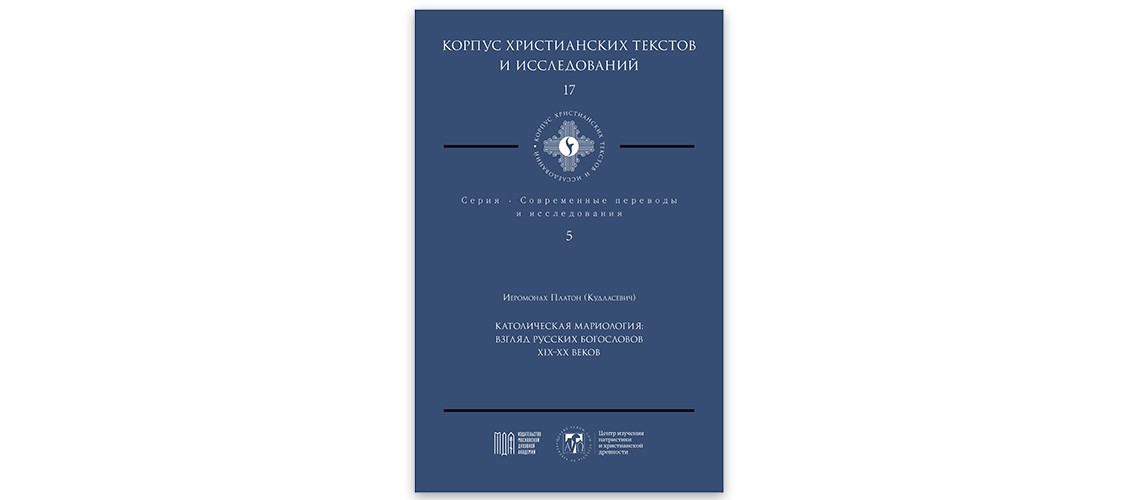
The MThA Publishing House has released the 5th monograph in the "Modern Translations and Studies" series, titled "Catholic Mariology: The View of Russian Theologians of the 19th–20th Centuries".
In the overall numbering, this is the 17th volume of the "Corpus of Christian Texts and Studies", a supplement to the journal "Bible and Christian Antiquity". The research was prepared by Hieromonk Platon (Kudlasevich). In this monograph, the author, from the standpoint of Russian theological thought, examines how the veneration of the Mother of God developed from the Roman Catholic Church's adoption of the dogma of the Immaculate Conception of the Virgin Mary until the conclusion of the Second Vatican Council.
The veneration of the Mother of God holds a special place in both the Orthodox and the Roman Catholic Church. Orthodox veneration of the Theotokos is closely connected with Christology, angelology, cosmology, and soteriology. In the East, the teaching about the Mother of God did not develop into a separate theological discipline—mariology—but was always inseparable from Christology. The term "mariology" is used primarily in Catholic theology, denoting the doctrine of the Most Holy Theotokos.
In the West, the teaching about the Mother of God developed as a specially highlighted proposition. In 1854, Pope Pius IX, through the encyclical Ineffabilis Deus ("Ineffable God"), established the dogma of the Immaculate Conception of the Virgin Mary. In 1950, the encyclical Munificentissimus Deus ("Most Bountiful God") of Pope Pius XII proclaimed the dogma of the Bodily Assumption of the Virgin Mary. At the Second Vatican Council (1962–1965), which made a special contribution to the development of mariology in the Roman Catholic Church, the dogmas of the Immaculate Conception and the Bodily Assumption of the Virgin Mary received confirmation.
The book demonstrates how the mariological dogma of 1854 (on the Immaculate Conception) led to the dogma of 1950 on the Bodily Assumption, and how both these dogmas, together with the Marian apparitions of recent centuries, determined the richness and diversity of contemporary mariological issues in Catholic thought.
The book will help contemporary Christians correctly place emphasis when considering mariological questions both in the Roman Catholic and Orthodox Churches; it can be useful to anyone interested in Christian doctrine.
Work continues at the "Center for Patristic and Christian Antiquity Studies" on publications that broaden the horizons of Christian scholarship and Christian antiquity; the next in line is a volume in the "Latin Texts and Studies" series.
Editor-in-Chief of the journal
"Bible and Christian Antiquity" and the CCTS
Deacon Sergei Kozhukhov
MThA Press Office